


For many affluent households, the investment challenge is not choosing growth or caution. It is deciding which wealth should compound over time, which should preserve stability, and which should stay accessible as life changes. High-net-worth investing is more effective when portfolio decisions are tied to purpose, timing, and family priorities.
This article explains how families can balance growth, preservation, and liquidity, why different pools of capital may need different expectations, and why strategy should be reviewed as goals evolve.
Key Takeaways for High-Net-Worth Family Investing
A strong high-net-worth family portfolio usually begins with clarity, not products. When each pool of capital has a defined role, families can evaluate tradeoffs with more confidence.
Different portions of wealth may need to support different goals.
Growth and preservation can coexist when time horizon and purpose are clear.
Liquidity can be a strategic source of flexibility, not simply idle capital.
Portfolio structure should reflect near-term needs, future opportunities, and long-term family intent.
Regular review helps keep investment strategy aligned as family life changes.
Why Should HNW Families Assign a Role to Each Pool of Capital?
HNW families should define what each part of their wealth is meant to accomplish because capital often has multiple jobs: lifestyle, liquidity, growth, legacy, or philanthropy.
A portfolio can appear efficient on paper and still feel misaligned in practice. A family preparing for education costs, real estate decisions, business opportunities, charitable giving, or future support may not want every asset managed with the same objective.
One helpful way to frame the portfolio is by the role each pool of capital plays:
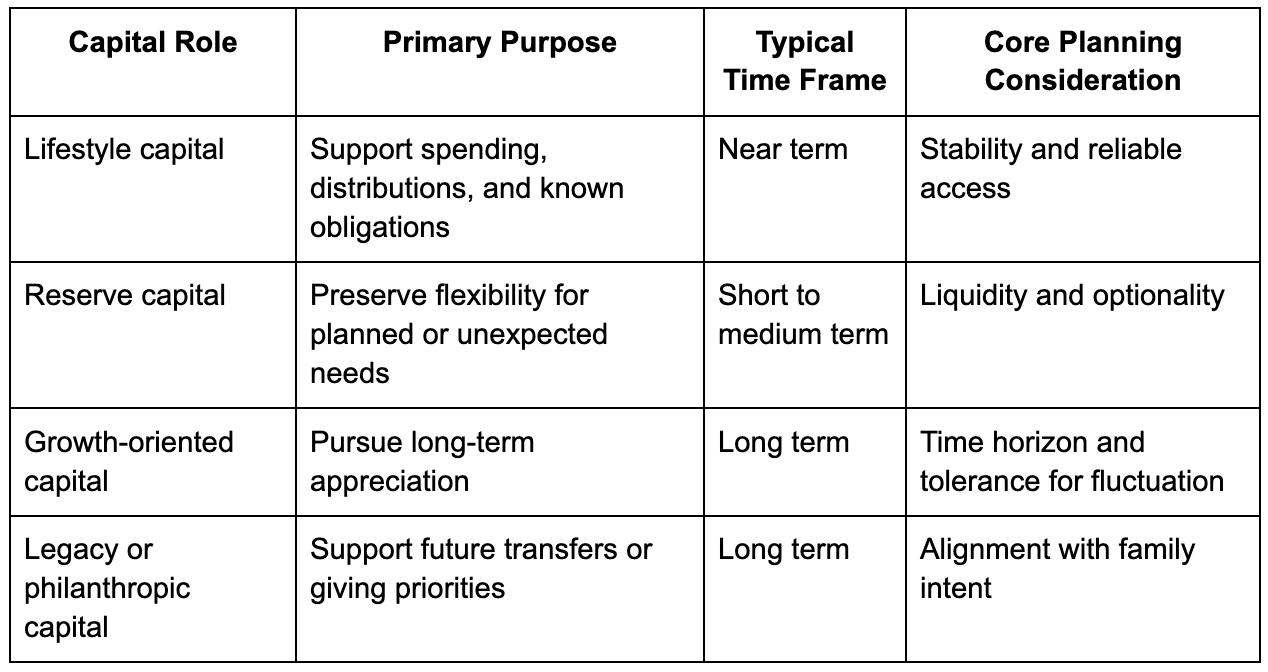
Growth and preservation can work together when the family separates long-term capital from money needed for stability or access. Preservation is about maintaining the ability to keep moving toward important goals through change.
The real tension appears when the same assets are expected to absorb near-term pressure and pursue long-term compounding. The portfolio may not be too aggressive or too conservative; it may simply be solving conflicting needs.
Several planning factors can help shape the balance:
When the money may be needed
How flexible the family can be with timing
Whether there are ongoing spending or distribution needs
How much disruption a market decline could create
Whether wealth is concentrated in a business, real estate, or another illiquid asset
A household with near-term commitments may define staying power differently than a family focused on multigenerational growth. The goal is to give each priority the structure it needs.
When Is Liquidity Strategic for Wealthy Families?
Liquidity is strategic when access to capital helps a family avoid rushed decisions, fund planned outflows, or respond to opportunities without disrupting longer-term assets. In that sense, liquidity can support flexibility as well as protection.
For affluent families, liquidity planning is often too narrowly framed as a return drag. Yet accessible capital can help with real estate decisions, education funding, charitable timing, private investment opportunities, family support, or tax obligations.
Different situations may call for different levels of accessible capital, including:
A family expecting major near-term cash needs
A household that recently experienced a liquidity event
A business owner who wants flexibility for future opportunities
A family with low spending needs and little demand for near-term access
The strategic question is whether ready access allows the family to act with more patience, confidence, and control. In the right context, liquidity can create room to make deliberate choices rather than reactive ones.
How Should Family Decision-Making Shape the Portfolio?
Family investment strategy should reflect how decisions are actually made, who needs to be involved, and which goals matter most. A portfolio can be technically sound and still feel disconnected if the family has not agreed on priorities.
For many HNW families, the harder work is clarifying what the wealth is for, how competing objectives should be weighed, and when tradeoffs should be revisited. Families benefit from naming what needs to remain flexible, which goals are shared priorities, and how decisions should be reviewed.
This is where comprehensive planning matters. Investment decisions tend to be stronger when coordinated with cash flow, taxes, estate planning, insurance, and family intent.
Why Should HNW Portfolios Be Reviewed as Goals Evolve?
High-net-worth portfolios should be reviewed regularly because the role of wealth can change. A strategy that fit one stage of life may need adjustment after a business sale, retirement transition, inheritance, or shift in priorities.
The goal is not to rebuild the portfolio around every market move. It is to test whether the structure still matches the jobs the wealth is expected to perform, including time horizons, liquidity needs, concentrated exposures, and long-term growth.
For a high-net-worth family portfolio, review is less about constant change and more about maintaining fit.
Frequently Asked Questions About HNW Family Investing
Families often understand the broad need to balance growth, preservation, and access. Practical questions surface when that framework is applied to real assets and family decisions.
Why is liquidity important for wealthy families?
Liquidity matters because affluent families may face large expenses, opportunities, or support decisions that do not align neatly with long-term investment timelines. Accessible capital can reduce the need to interrupt longer-term holdings.
Can a portfolio support both growth and preservation?
Yes. The balance comes from matching each pool of capital to its purpose and time horizon. Long-term assets may pursue growth, while near-term or reserve assets may focus more on stability and access.
Should every dollar in a family portfolio have the same objective?
Usually not. Wealth may need to support lifestyle spending, reserves, long-term appreciation, legacy goals, and charitable intent. Treating every dollar the same can create unnecessary tension.
How often should family investment priorities be reviewed?
A periodic review is useful because goals, obligations, and timing assumptions change. Reviews are especially important after retirement, a business sale, a liquidity event, inheritance, or a major family transition.
What makes HNW family investing different from traditional portfolio planning?
The complexity often comes from competing priorities. HNW portfolios may need to coordinate lifestyle needs, concentrated wealth, taxes, estate planning, family governance, philanthropy, and multigenerational intent.
A Stronger Portfolio Starts With Clear Purpose
High-net-worth investing is less about finding one perfect portfolio and more about aligning capital with the roles it needs to play. Families often make better decisions when they separate money meant for growth, staying power, and access.
If your family wants to review whether your investment strategy reflects the totality of your financial life, goals, and future decisions, contact Totus Wealth Management to schedule a meeting.